
Live
2.70% edge
European Roulette
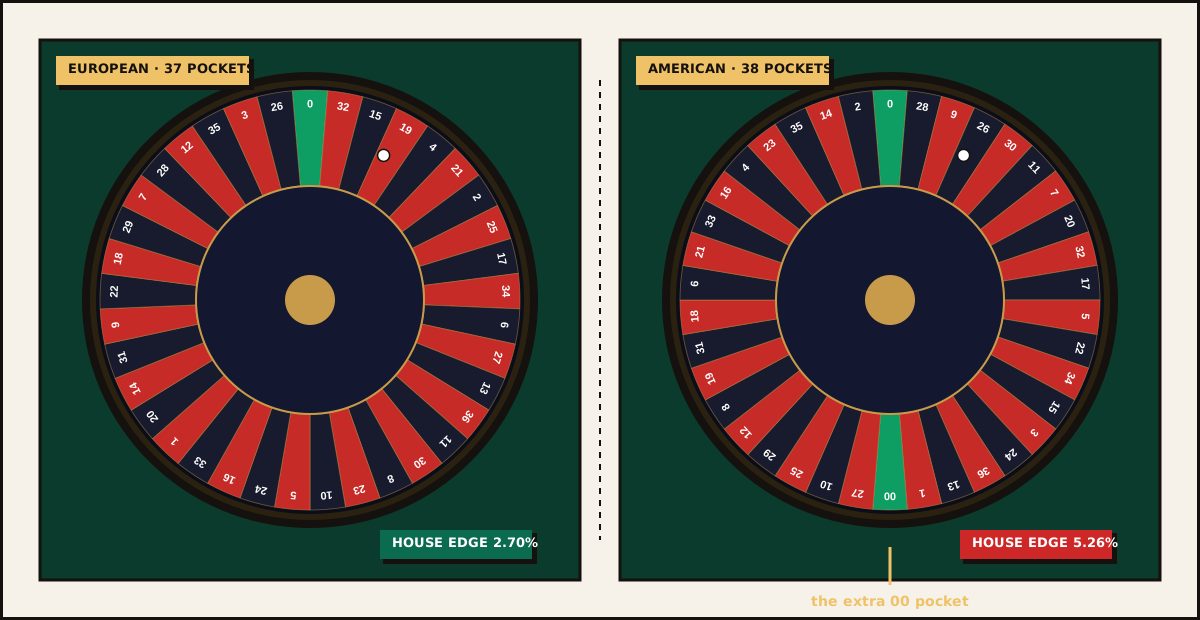
Single-zero wheel, 37 pockets, 2.70% house edge on every bet on the layout.
RTP 97.30%
Play free
Spin a full-speed wheel and record results — no bets, no balance, just data.
—
—
Hot and cold numbers are the clearest demonstration of the gambler's fallacy available. Run 1,000 spins repeatedly: the lists change completely every time, because they are noise, not signal.
Run a thousand spins and note the six hottest numbers. Reset and run another thousand. The lists will barely overlap. On a fair wheel every pocket has exactly the same probability on every spin, and clustering is what randomness looks like — not evidence of a pattern.
Live casinos display recent results on a screen beside every table. They are not doing this to help you.
At 100 spins the distribution looks wildly uneven. At 10,000 it flattens toward the dashed expected line. This is the law of large numbers doing its work — and it is also why the house edge is a certainty for the casino, which plays millions of spins, and only a probability for you, who plays a few hundred.
1. Run 1,000 spins twice. Write down the six hottest numbers after the first run, reset, and run it again. The lists will barely overlap. That is what “hot numbers” are — the visible texture of randomness, with no predictive content.
2. Watch the distribution converge. At 100 spins the bars look wildly uneven. At 10,000 they flatten toward the expected line. Nothing corrects the early imbalance; it simply becomes a smaller fraction of a larger total. That distinction is the whole of the gambler's fallacy.
Every live roulette table, physical and online, displays recent results on a board. The information is genuinely useless — each spin is independent — and it is displayed anyway.
It is there because it encourages betting. A player who sees five reds either backs red to continue or backs black to correct, and both readings produce the same thing: another wager on a 2.70% game. The board is not deception; the numbers are real. It is just an invitation to find a pattern in a sequence that does not contain one.
Everything on this page is computed in your browser. Nothing you type is transmitted, logged or stored anywhere, there is no account, and the page works offline once loaded. The source is plain JavaScript in the page itself — you are welcome to read it.
All our figures use published paytables and pocket counts. If you find a number here you believe is wrong, tell us: we correct in place and change the date at the top of the page.

Former live-casino dealer turned probability writer. Builds every simulator on this site.
On a fair wheel, no. Clustering is a normal property of random sequences. Run the simulator twice and compare the lists — they will not match.
Historically yes, and a handful of players profited from it decades ago. Modern wheels are machined to tolerances that make exploitable bias vanishingly rare, and online RNG wheels have no physical bias at all.
Every tool on this site is designed to be used next to a demo table. Open one in another tab.
Single-zero wheel, 37 pockets, 2.70% house edge on every bet on the layout.
Double-zero wheel. The extra pocket nearly doubles the house edge to 5.26%.
Single zero plus La Partage — even-money bets lose only half when zero lands.