The claim, and why it fails
Every roulette system is a rule for sizing the next bet based on what happened before. The implicit claim is that sequencing can turn a negative-expectation game positive.
It cannot, and the reason is short enough to fit in a sentence: expected value is additive. If every individual bet has an expected value of −2.70% of its stake, then any collection of such bets has an expected value of −2.70% of total stakes, in any order, at any sizes. There is no arrangement of negative numbers that sums to a positive one.
What systems genuinely do is reshape the distribution of outcomes. That is not nothing — some players sincerely prefer many small wins and rare large losses — but it is not an edge.
Martingale
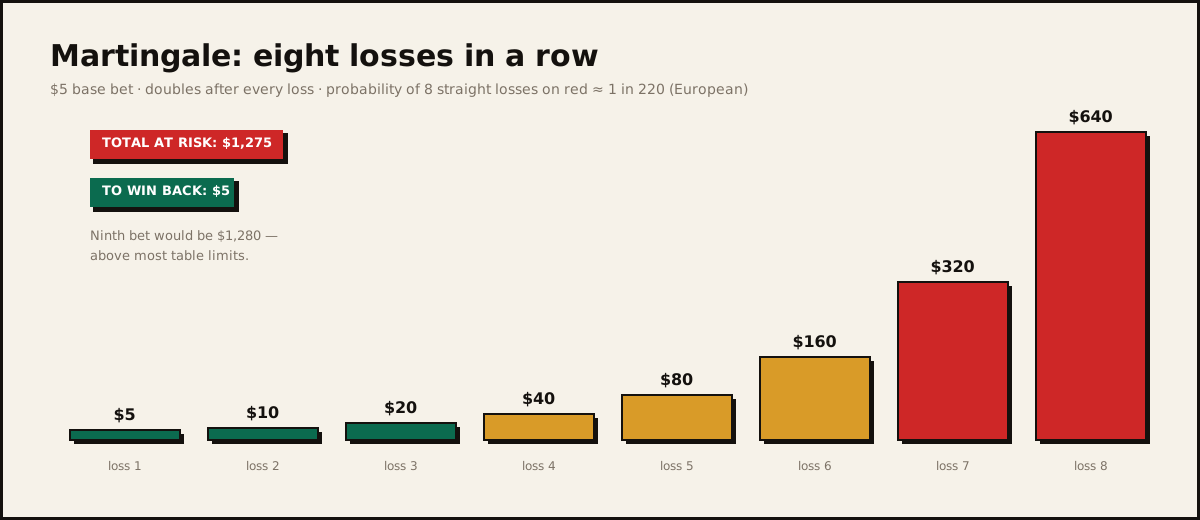
Double your bet after every loss; return to base after a win. Each win recovers all prior losses in the sequence plus one unit.
What actually happens: you win small amounts very often and occasionally lose everything. Starting at $10 with a $1,000 bankroll, you can survive six consecutive losses; the seventh requires $640 and you are already $630 down. A seven-loss run happens roughly once every 150 sequences — which on a busy evening is not rare at all.
Table limits make it worse. A $10 table with a $500 maximum caps you at six doublings whether or not you have the bankroll for a seventh.
Reverse Martingale (Paroli)
Double after a win, reset after a loss, usually capping at three wins.
The mirror image: many small losses punctuated by occasional larger wins. Risk per sequence is capped at one unit, which makes it far safer to play than Martingale. The expectation is, inevitably, identical.
D'Alembert
Increase by one unit after a loss, decrease by one after a win. Gentler than doubling, based on the idea that wins and losses 'balance out'.
They do not balance out — they diverge in absolute terms while converging in proportion. D'Alembert lasts longer than Martingale before disaster, and costs exactly the same per unit wagered.
Fibonacci
Step forward through 1, 1, 2, 3, 5, 8, 13… after each loss; step back two places after a win.
Escalation is slower than Martingale, so bankroll survival is better, but the recovery is incomplete — you can climb the sequence, win, and still be behind. The mathematical elegance of the sequence contributes nothing to the result.
Labouchère
Write a line of numbers. Bet the sum of the first and last. On a win, cross both off; on a loss, append the amount lost to the end. The line clears when you have won the target.
It feels like bookkeeping toward a goal, and that is the appeal. In practice the line grows faster than it shrinks during a bad run, and bet sizes escalate sharply. Same expectation as everything else.
Flat betting — the honest baseline
Stake the same amount every spin. Your result is turnover × edge plus variance, with no escalation and no dramatic bust risk.
This is what we recommend, not because it wins — it does not — but because it makes the cost of the evening visible and predictable. You know what you are spending, which is the only form of control available in a game with no decisions.
Test it yourself
Our strategy simulator runs any of these over thousands of sessions and reports the average, the median, the bust rate and the distribution. Set it to 5,000 sessions and compare Martingale against flat betting. The averages land in the same place. That is the argument, made by your own browser rather than by us.
What a system would have to do to work
For a betting system to beat roulette, it would have to change at least one of three things: the probability of each pocket, the payout on a winning bet, or the independence of successive spins. A rule about bet sizing touches none of them.
This is not an opinion about systems, it is arithmetic. The only historically successful attacks on roulette changed the first item — by finding a physically biased wheel — or predicted ball deceleration with a timing device. Both are closed on modern equipment, and neither was a betting progression.
The psychology that keeps systems alive
Progression systems survive because they are pleasant to play. Martingale wins the large majority of sessions. A player can run it for months and collect a long series of small wins, each of which feels like evidence.
The loss, when it comes, is large enough to erase all of them, and it arrives without warning because there is no signal to read. Human memory handles that badly: a hundred small wins feel like a pattern, and one large loss feels like bad luck. The arithmetic says they are the same event viewed from two ends.
This is why we built the simulator rather than writing another essay. Set it to 5,000 sessions and the distribution does the arguing.
Things that genuinely reduce what you pay
- Play a single-zero wheel. Halves the edge against an American table.
- Find La Partage. Halves it again on even-money bets, to 1.35%.
- Slow down. Cost scales linearly with spins per hour. A dealt table can be a third the price of fast RNG roulette at the same stake.
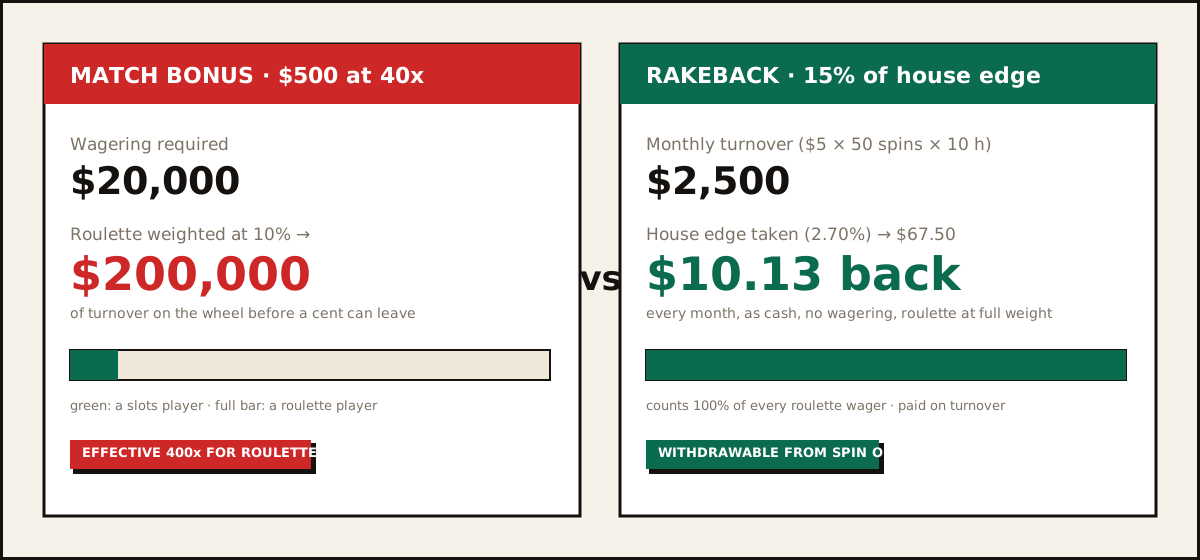
- Take rakeback over a weighted match bonus. Rakeback counts roulette at full weight and is normally withdrawable cash.
- Flat bet. Not because it wins, but because it keeps the cost visible and the bust risk low.
That list is complete. Anything not on it — hot numbers, dealer signature at an online table, sector targeting, any product sold on a promise — does not change the number.
Putting this into practice
Reading changes very little on its own. Three things reliably do.
First, open a free table and play 200 spins flat. Watch how the balance moves, how long the swings last, and how quickly 200 spins actually goes. That is the texture of the game, and it is not what most people expect.
Second, put your real stake and session length into the bankroll calculator. The hourly cost it returns is the honest price of the entertainment. If that number is comfortable, the rest is detail. If it is not, lower the stake or slow the table — those are the only two levers that work.
Third, if you are comparing casino offers, run them through the wagering calculator before you deposit rather than after.