The object of the game
A ball is released onto a spinning wheel divided into numbered pockets. You bet on where it will come to rest. That is the entire game — everything else is a question of which grouping of pockets you back and what that grouping pays.
Roulette has no decisions after the bet is placed. Unlike blackjack or poker, skill cannot improve your result once the ball is in motion. What skill exists is entirely in the selection: which table you sit at, how much you stake, and how long you stay.
The order of play
- The dealer opens betting. Chips go on the layout.
- The wheel is already spinning; the ball is released against its rotation.
- Betting closes — 'rien ne va plus' — usually while the ball is still circling.
- The ball drops, hits the deflectors and settles in a pocket.
- The dealer marks the winning number with a dolly, clears losing bets, pays winners.
- The dolly is removed and the next round opens.
Online, the sequence is identical; the software simply handles the clearing and paying instantly.
Inside bets
Bets placed on the numbered grid. They win rarely and pay heavily.
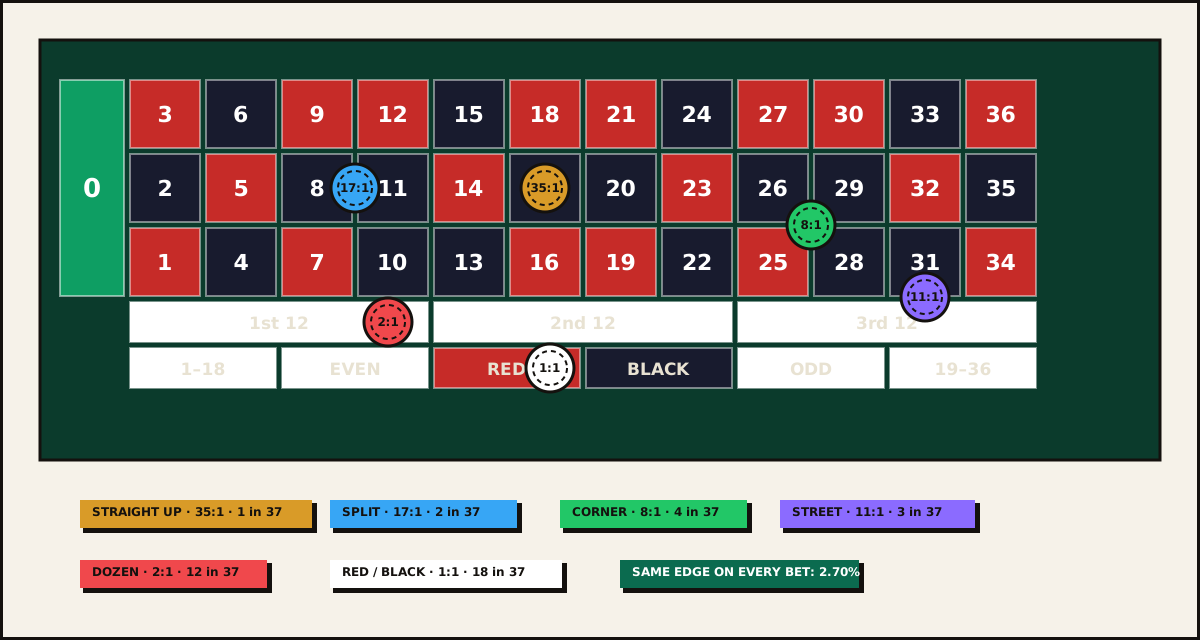
- Straight up — one number, chip in the centre of the box. Pays 35:1.
- Split — two adjacent numbers, chip on the line between them. Pays 17:1.
- Street — three numbers in a row, chip on the outer edge. Pays 11:1.
- Corner — four numbers meeting at a point, chip on the intersection. Pays 8:1.
- Six line — two adjacent rows, chip on the outer edge between them. Pays 5:1.
- Top line — American wheels only: 0, 00, 1, 2, 3. Pays 6:1 and should be avoided; its house edge is 7.89%.
Outside bets
Bets placed in the boxes around the grid. They win often and pay little.
- Red / Black — eighteen numbers. Pays 1:1.
- Odd / Even — eighteen numbers. Pays 1:1.
- 1–18 / 19–36 — eighteen numbers. Pays 1:1.
- Dozens — 1–12, 13–24 or 25–36. Pays 2:1.
- Columns — one of the three vertical lines of twelve. Pays 2:1.
Zero is not red, not black, not odd and not even. Every even-money bet loses when zero lands — unless the table applies La Partage, which returns half.
Called bets and wheel sections
French and some European tables accept announced bets covering sections of the wheel rather than the layout:
- Voisins du Zéro — the seventeen numbers around zero, nine chips.
- Tiers du Cylindre — the twelve numbers opposite zero, six chips.
- Orphelins — the eight numbers left over, five chips.
- Jeu Zéro — a compact seven-number bet around zero, four chips.
They are shorthand for placing several splits and straights at once. They carry no edge advantage whatsoever — the convenience is real, the value is not.
Etiquette that still matters online
At a physical table: buy colour chips from the dealer rather than using cash chips, do not touch your bet after 'no more bets', and never touch the dolly. Online none of this applies, but two habits transfer usefully — decide your stake before the round opens, and do not chase a loss into the next spin.
Table limits, and why they exist
Every roulette table carries a minimum and a maximum, and they are usually quoted separately for inside and outside bets. A $5/$500 table might accept $5 total across your inside bets but require $5 on each outside bet, with $500 the cap on any single outside wager.
The maximum is not there to stop you winning. It is there to bound the casino's exposure on a single spin and, incidentally, to make progression betting impossible to run to its logical end. A $10 Martingale hits a $500 ceiling after six consecutive losses, which happens roughly once in every 150 sequences.
Live dealer, RNG and the difference that matters
A live table streams a real wheel from a studio. An RNG table draws a number from a certified generator. The house edge is identical; the pocket count and paytable decide that, not the delivery method.
What differs is speed, and speed is cost. A dealt table runs 30–45 spins an hour. Auto roulette runs 60–80. RNG roulette can run past 110 if you keep clicking. At $10 a spin on a European wheel that is the difference between $10 and $30 an hour in expectation, for a game that feels identical.
Reading a paytable before you sit down
Three checks, in this order, take about fifteen seconds and decide most of what a session will cost.
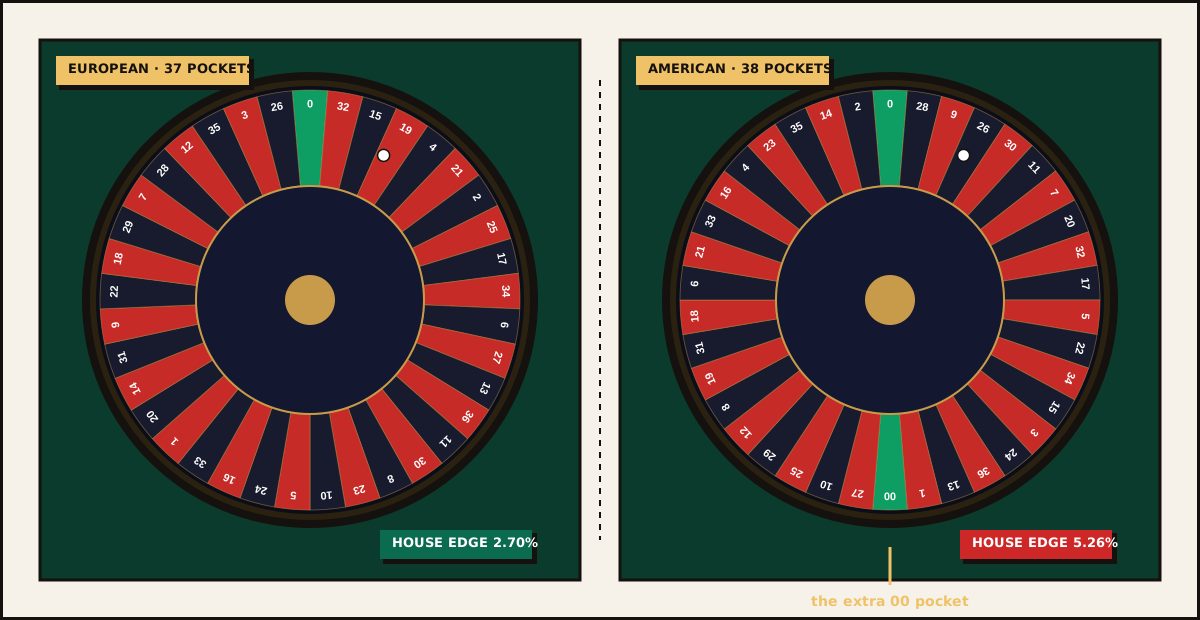
- Count the green pockets. One is European. Two is American, and costs roughly double.
- Look for La Partage or En Prison. Either halves the edge on even-money bets to 1.35%.
- Check the straight-up payout. 35:1 is standard. 29:1 means a Lightning-style variant with multipliers. 11:1 means a 13-pocket mini wheel and a much higher edge.
Putting this into practice
Reading changes very little on its own. Three things reliably do.
First, open a free table and play 200 spins flat. Watch how the balance moves, how long the swings last, and how quickly 200 spins actually goes. That is the texture of the game, and it is not what most people expect.
Second, put your real stake and session length into the bankroll calculator. The hourly cost it returns is the honest price of the entertainment. If that number is comfortable, the rest is detail. If it is not, lower the stake or slow the table — those are the only two levers that work.
Third, if you are comparing casino offers, run them through the wagering calculator before you deposit rather than after.