
Live
2.70% edge
European Roulette
Single-zero wheel, 37 pockets, 2.70% house edge on every bet on the layout.
RTP 97.30%
Play free
Run Martingale, D'Alembert, Fibonacci and flat betting over thousands of spins.
Distribution of finishing bankrolls. Watch what happens to Martingale as you raise the spin count: the win rate stays high and the average result keeps converging on the same expected loss, because the rare busts are enormous.
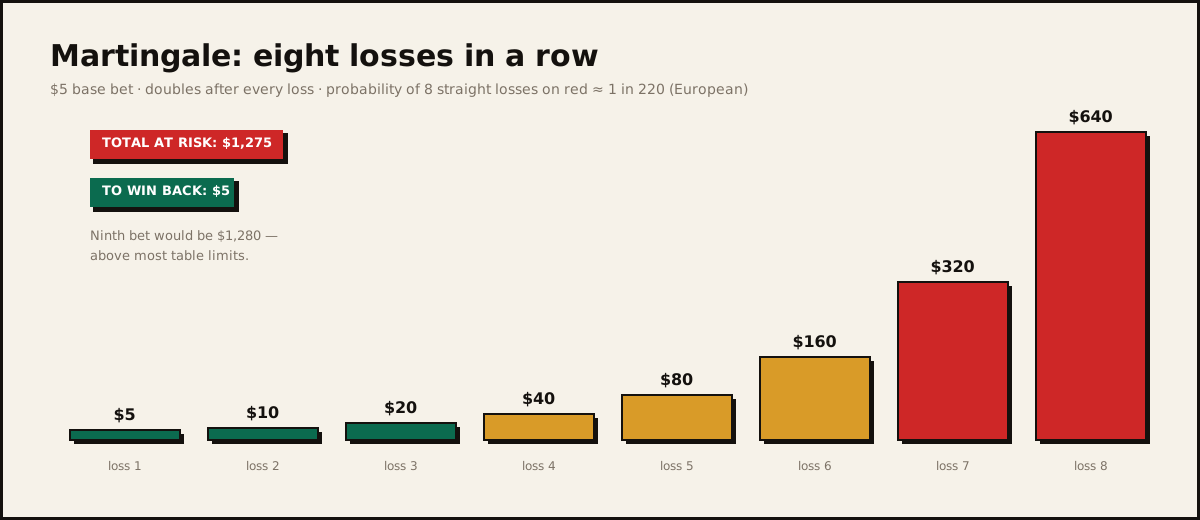
Run Martingale over 500 spins with a $1,000 bankroll and you will usually finish ahead. Run it 5,000 times and look at the average: it lands on the same expected loss as flat betting. The win-rate column and the bust column tell the whole story — Martingale converts many small wins into rare catastrophic losses of exactly equivalent total size.
That is not a flaw in the implementation. It is a mathematical certainty. No sequence of bets on a negative-expectation game can produce a positive expectation, because expectation is additive and every individual bet is negative.
Flat — same stake every spin. The honest baseline.
Martingale — double after a loss. Hits the table maximum or your bankroll eventually, and the loss when it does erases every prior win.
Reverse Martingale — double after a win. Many small losses, rare large wins. The mirror image, same expectation.
D'Alembert — up one unit on a loss, down one on a win. Gentler than Martingale, equally powerless.
Fibonacci — step through the sequence on losses. Slower escalation, same ending.
Labouchère — cross off a line of numbers. Elaborate bookkeeping, identical expectation.
1. Martingale, 500 spins, 1,000 sessions. Note the win rate — it will be high. Now note the average finishing bankroll, and compare it with flat betting at the same settings. They land in the same place.
2. The same run at 5,000 spins. The win rate collapses and the bust rate climbs. Nothing changed except the number of opportunities for a long losing streak to appear.
3. European versus American, flat betting. Same strategy, same stake. The average result on the double-zero wheel is roughly twice as far below the starting bankroll. That gap is the only thing on this page you can actually control.
The histogram shows where finishing bankrolls landed across every simulated session. The dashed line marks where you started; bars to its right are winning sessions, bars to its left are losing ones.
With flat betting the distribution is roughly symmetrical and centred slightly left of the line — that offset is the house edge, made visible. With Martingale the shape changes completely: a tall cluster just right of the line, and a long thin tail running all the way to zero. Same centre of mass, very different ride.
Everything on this page is computed in your browser. Nothing you type is transmitted, logged or stored anywhere, there is no account, and the page works offline once loaded. The source is plain JavaScript in the page itself — you are welcome to read it.
All our figures use published paytables and pocket counts. If you find a number here you believe is wrong, tell us: we correct in place and change the date at the top of the page.

Former live-casino dealer turned probability writer. Builds every simulator on this site.
It produces a high win rate over short sessions and catastrophic losses over long ones, averaging out to exactly the same expected loss as flat betting. Run the simulator with 5,000 sessions and watch it happen.
No. Expected value is additive: a sequence of negative-expectation bets has negative expectation, whatever order or size they come in.
Because most progression systems win most of the time. The losses are rare and enormous, which makes them easy to dismiss as bad luck rather than as the mathematically required counterweight.
Every tool on this site is designed to be used next to a demo table. Open one in another tab.
Single-zero wheel, 37 pockets, 2.70% house edge on every bet on the layout.
Double-zero wheel. The extra pocket nearly doubles the house edge to 5.26%.
Single zero plus La Partage — even-money bets lose only half when zero lands.