The one calculation underneath everything
House edge on a roulette bet is the gap between true odds and payout odds, expressed as a fraction of the stake. Formally:
Edge = 1 − p × (payout + 1)
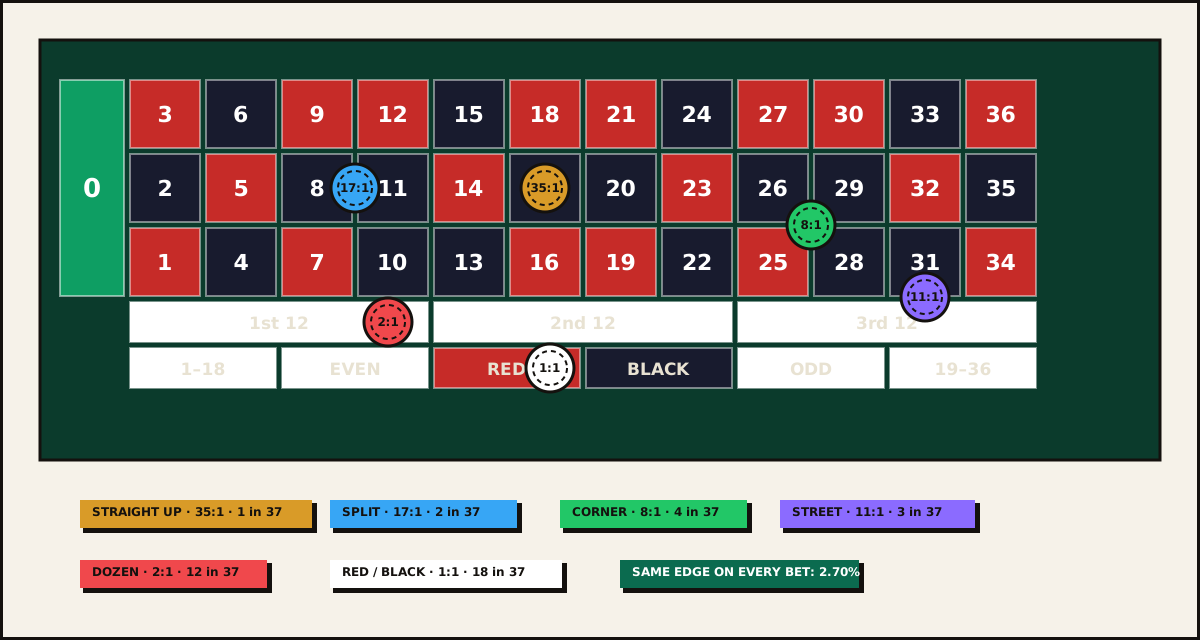
Where p is the probability of winning. For red on a European wheel: 1 − (18/37) × 2 = 0.027, or 2.70%. For a straight-up bet: 1 − (1/37) × 36 = 0.027. Identical — which is the whole design of the paytable.
Complete odds table — European wheel
| Bet | Numbers | Probability | True odds | Pays | Edge |
|---|---|---|---|---|---|
| Straight up | 1 | 2.70% | 36:1 | 35:1 | 2.70% |
| Split | 2 | 5.41% | 17.5:1 | 17:1 | 2.70% |
| Street | 3 | 8.11% | 11.3:1 | 11:1 | 2.70% |
| Corner | 4 | 10.81% | 8.25:1 | 8:1 | 2.70% |
| Six line | 6 | 16.22% | 5.17:1 | 5:1 | 2.70% |
| Column / dozen | 12 | 32.43% | 2.08:1 | 2:1 | 2.70% |
| Red / black | 18 | 48.65% | 1.06:1 | 1:1 | 2.70% |
Complete odds table — American wheel
| Bet | Numbers | Probability | True odds | Pays | Edge |
|---|---|---|---|---|---|
| Straight up | 1 | 2.63% | 37:1 | 35:1 | 5.26% |
| Split | 2 | 5.26% | 18:1 | 17:1 | 5.26% |
| Street | 3 | 7.89% | 11.7:1 | 11:1 | 5.26% |
| Corner | 4 | 10.53% | 8.5:1 | 8:1 | 5.26% |
| Top line | 5 | 13.16% | 6.6:1 | 6:1 | 7.89% |
| Column / dozen | 12 | 31.58% | 2.17:1 | 2:1 | 5.26% |
| Red / black | 18 | 47.37% | 1.11:1 | 1:1 | 5.26% |
Streak probabilities, because everyone asks
On a European wheel, the chance of red winning n times consecutively is (18/37)^n:
- 2 in a row — 23.7%
- 3 — 11.5%
- 5 — 2.7%
- 7 — 0.65%
- 10 — 0.07% (about 1 in 1,400)
- 15 — about 1 in 74,000
All of these describe a sequence before it starts. Once nine reds have landed, the probability of the tenth being red is 48.65%, exactly as it was for the first. The previous spins are not stored anywhere — not in the wheel, not in the ball, not in the RNG.
What the numbers mean for a real session
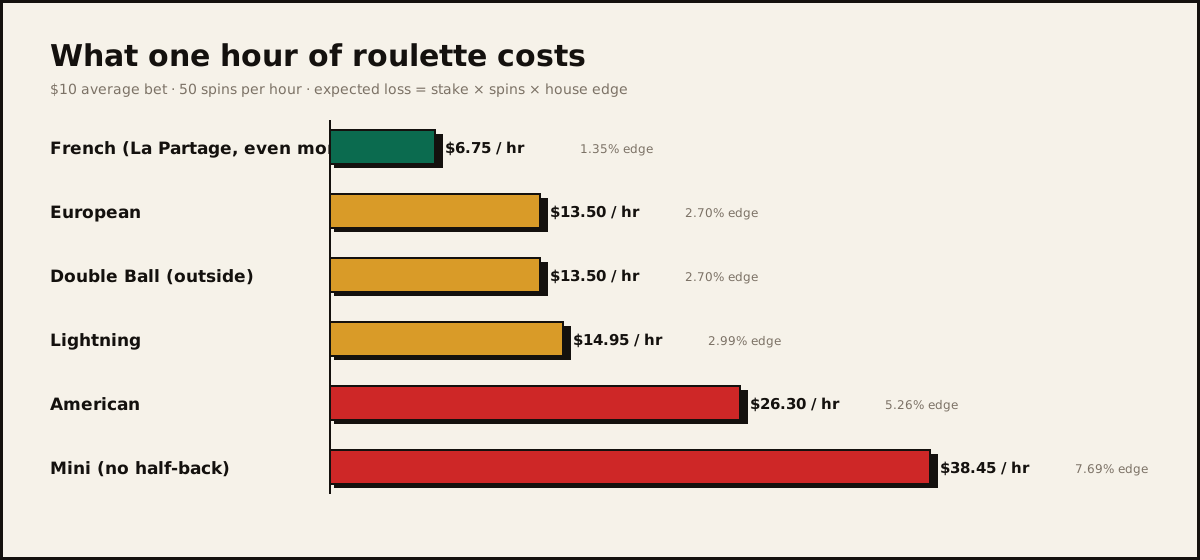
Expected loss = turnover × edge. At $10 a spin, 50 spins an hour, three hours: $1,500 of turnover, $40.50 expected cost on a European wheel, $78.90 on an American one, $20.25 on a French table with La Partage.
The standard deviation over those 150 even-money spins is roughly $122, which is why your actual result will be nowhere near the expectation. Budget for the expectation; prepare for the deviation.
Combining bets does not change the edge
A common belief is that covering more of the layout improves your position. It does not. Expected value is additive: if every individual bet returns −2.70% of its stake, then any combination of them returns −2.70% of total stakes.
Betting red plus the third dozen, for example, creates a pleasing overlap where some numbers pay twice. It also creates numbers that lose both bets. Work through all 37 outcomes and the total lands on exactly the same figure as betting the same total on red alone. What changes is the shape of the distribution, not its centre.
Variance: the number nobody quotes
House edge tells you the average. Standard deviation tells you how far from average a real session is likely to land, and it is by far the larger number over short runs.
For even-money bets, standard deviation over n spins at stake s is roughly s × √n. A hundred $10 spins: expected loss $27, standard deviation about $100. Two thirds of sessions finish between −$127 and +$73, and one in twenty finishes outside ±$200.
For straight-up bets the spread is about six times wider. That is why the same bankroll supports a far shorter session on inside bets, and why people who bet straight up remember roulette as wildly swingy while even-money players remember it as a slow grind.
Probability questions people actually ask
| Question | European | American |
|---|---|---|
| Chance a chosen number hits in 37 spins | 63.7% | 62.3% |
| Chance a chosen number hits in 100 spins | 93.4% | 93.0% |
| Spins for a 50% chance of a given number | 25 | 26 |
| Chance of no zero in 37 spins | 36.3% | 13.9% (no zero or 00) |
| Chance of 5 reds in a row | 2.7% | 2.4% |
| Chance of 10 reds in a row | 0.073% | 0.057% |
Every one of these describes a sequence before it begins. None of them says anything about the next spin once part of the sequence has already happened.
Putting this into practice
Reading changes very little on its own. Three things reliably do.
First, open a free table and play 200 spins flat. Watch how the balance moves, how long the swings last, and how quickly 200 spins actually goes. That is the texture of the game, and it is not what most people expect.
Second, put your real stake and session length into the bankroll calculator. The hourly cost it returns is the honest price of the entertainment. If that number is comfortable, the rest is detail. If it is not, lower the stake or slow the table — those are the only two levers that work.
Third, if you are comparing casino offers, run them through the wagering calculator before you deposit rather than after.