The layout is not random
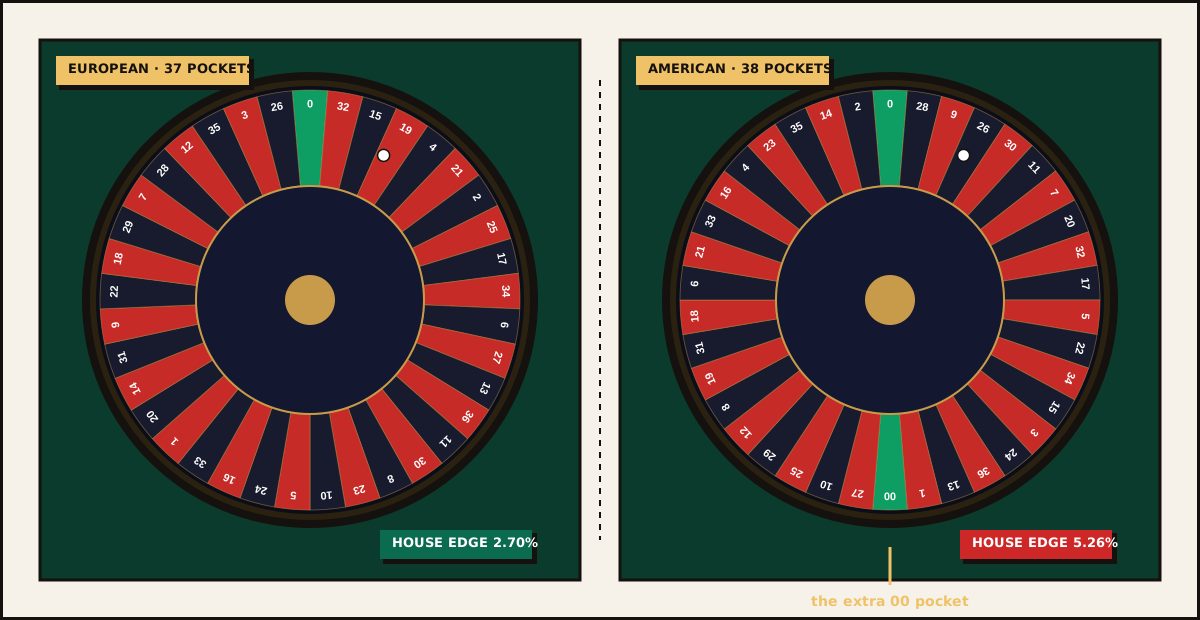
Numbers on a roulette wheel are not arranged in sequence, and their order is not arbitrary either. The pattern satisfies several constraints at once: red and black alternate, high and low numbers are distributed evenly around the rim, and odd and even are balanced across any half.
The purpose is to make any section of the wheel roughly representative of the whole, so that a slightly biased wheel or a dealer with a consistent release cannot easily favour a category of bet.
European wheel order
Clockwise from zero:
0, 32, 15, 19, 4, 21, 2, 25, 17, 34, 6, 27, 13, 36, 11, 30, 8, 23, 10, 5, 24, 16, 33, 1, 20, 14, 31, 9, 22, 18, 29, 7, 28, 12, 35, 3, 26
Red and black alternate perfectly around the entire rim, broken only by the green zero. Each consecutive pair of numbers sums to an odd total in most cases, and the nine-number arcs are close to balanced for high/low.
American wheel order
Clockwise from zero:
0, 28, 9, 26, 30, 11, 7, 20, 32, 17, 5, 22, 34, 15, 3, 24, 36, 13, 1, 00, 27, 10, 25, 29, 12, 8, 19, 31, 18, 6, 21, 33, 16, 4, 23, 35, 14, 2
The American wheel places numbers in pairs directly opposite one another (1 opposite 2, 3 opposite 4, and so on), with the two zeros facing each other. It is a different design philosophy and, as a side effect, distributes high and low numbers less evenly than the European wheel.
Wheel sections and called bets
Because the wheel order differs from the layout order, betting a section of the wheel means placing several scattered chips on the felt. French tables formalise three sections:
- Voisins du Zéro — 22 through 25 going clockwise past zero: seventeen numbers.
- Tiers du Cylindre — 27 through 33 on the far side: twelve numbers.
- Orphelins — the two remaining arcs: eight numbers.
These are useful shorthand and nothing more. Every chip placed is a standard split or straight at standard odds.
Does the layout create exploitable patterns?
On a modern wheel, no. Twentieth-century advantage players did find wheels with mechanical bias — a loose fret, a tilted rotor — and profited from thousands of recorded spins. Contemporary wheels are machined, balanced and regularly rotated between positions, and casinos monitor their own results far more carefully than any player can.
Online RNG roulette has no physical wheel at all, so no physical bias is possible. Live-streamed roulette uses real wheels under the same maintenance regime as a floor table.
Wheel order versus layout order
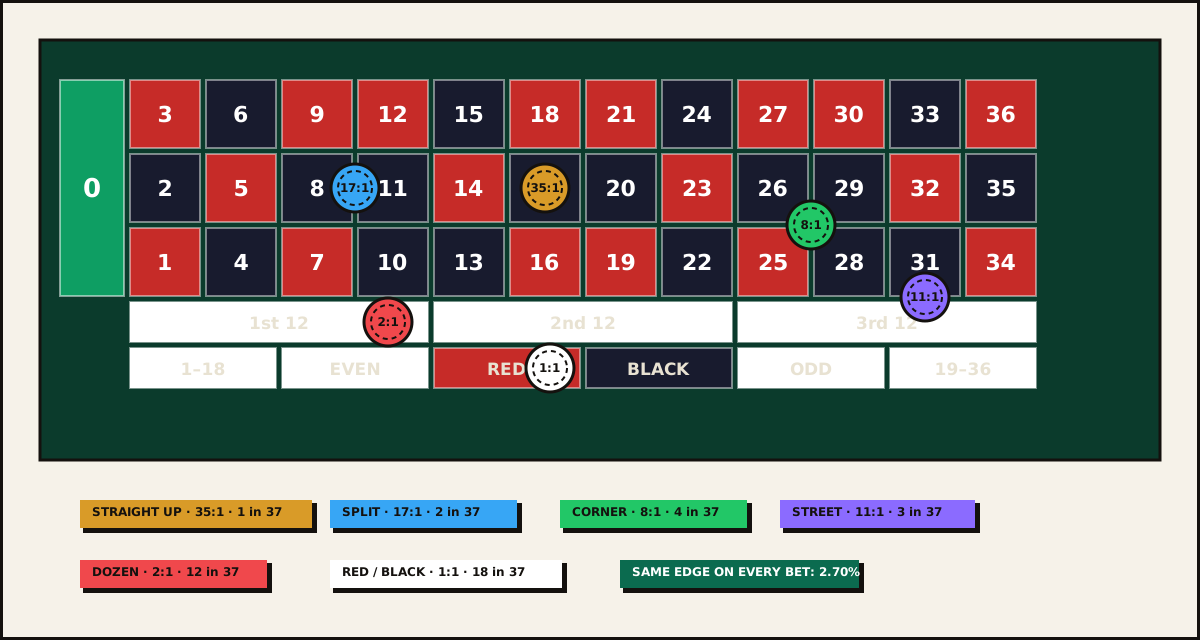
The felt is arranged in numerical order, three columns of twelve. The wheel is not. That mismatch is deliberate and it has a practical consequence: a bet that looks compact on the layout is scattered around the rim, and a bet that covers a neat arc of the wheel takes several separated chips on the felt.
Neither arrangement is better value. It is worth understanding only so that called bets stop looking mysterious — Voisins du Zéro is nine chips placed in specific spots because those spots happen to cover seventeen adjacent pockets.
Wheel bias, and why it is effectively dead
A mechanically biased wheel favours certain pockets — a loose fret, a worn ball track, a rotor sitting fractionally off level. In the twentieth century a handful of teams found such wheels and profited: Joseph Jagger at Monte Carlo in 1873 is the famous case, and there were later ones in Argentina and Nevada.
Detecting bias requires thousands of recorded spins from a single wheel to separate signal from noise, and modern casinos run that analysis on their own equipment continuously, rotate wheels between tables and replace parts on a schedule. Online RNG roulette has no physical wheel at all, so no physical bias is possible.
Dealer signature
The theory: a dealer who releases the ball with consistent timing and force from a consistent position will produce results clustered in a predictable sector. The practice: casinos rotate dealers, vary release points and instruct staff to break rhythm precisely because of this.
Online it is irrelevant. RNG tables have no dealer, and live-streamed tables are dealt under the same rotation rules as a floor table — with the added problem that you cannot see the ball's release point clearly enough to time it.
Putting this into practice
Reading changes very little on its own. Three things reliably do.
First, open a free table and play 200 spins flat. Watch how the balance moves, how long the swings last, and how quickly 200 spins actually goes. That is the texture of the game, and it is not what most people expect.
Second, put your real stake and session length into the bankroll calculator. The hourly cost it returns is the honest price of the entertainment. If that number is comfortable, the rest is detail. If it is not, lower the stake or slow the table — those are the only two levers that work.
Third, if you are comparing casino offers, run them through the wagering calculator before you deposit rather than after.