
1
 Roobet
Best overall for roulette
Roobet
Best overall for roulette
100% bonus up to $1,000
40x bonus, roulette weighted 10%
4.8
roospins
Last used recently
No expiry date
Single-zero wheel, 37 pockets, 2.70% house edge on every bet on the layout. $1,000 play money, no account, no download.
Swipe the layout sideways on a phone to reach every bet.
European roulette is the single-zero game and the baseline against which every other variant should be judged. Thirty-seven pockets, one green zero, and a house edge of exactly 2.70% on every single bet available on the felt — inside or outside, it makes no difference.
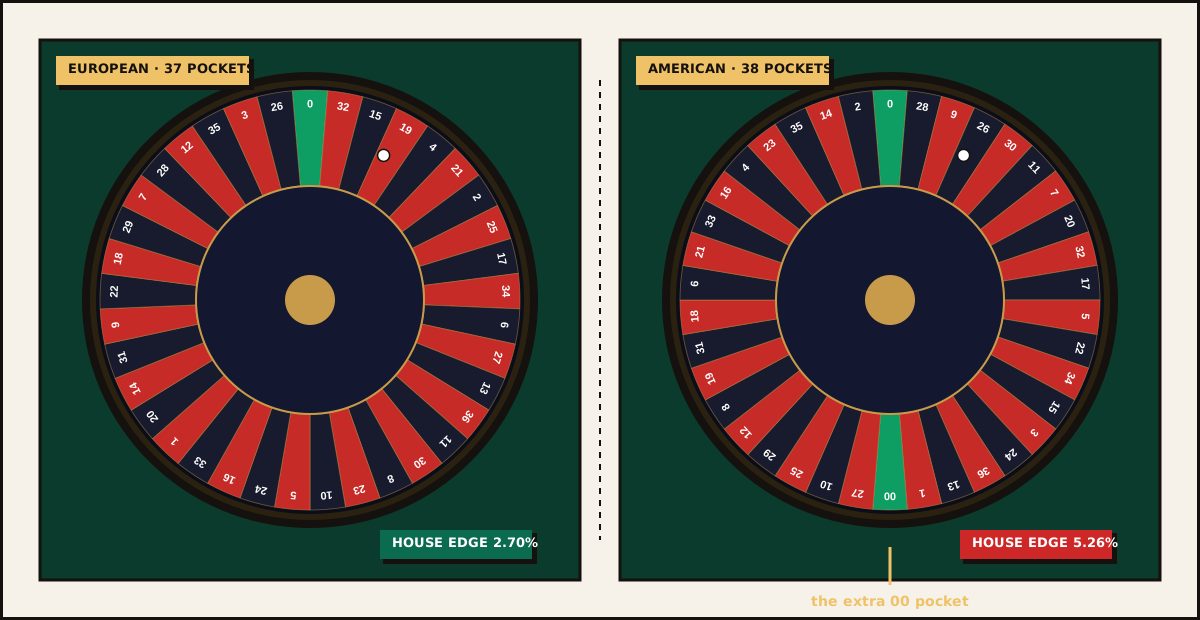
Thirty-seven pockets, numbered zero to thirty-six. Eighteen red, eighteen black, one green zero. A straight-up bet pays 35 to 1 against true odds of 36 to 1, and that single missing unit is the entire house edge: 1/37 = 2.70%.
The elegance of the single-zero game is that the edge is identical everywhere on the felt. Betting a number, a corner, a dozen or red makes no difference to expectation whatsoever — only to variance. A straight-up bettor and a red/black bettor staking the same total over the same number of spins have exactly the same expected loss. One of them will simply have a far wilder ride getting there.
The dealer (or the RNG, in an online game) releases the ball against the rotation of the wheel. Once the ball drops below the rim it hits the deflectors, loses its remaining energy and settles into a pocket. In a properly maintained wheel every pocket is equally likely — which is the part people find hardest to accept after watching red land nine times.
Nine reds in a row has a probability of about 1 in 700 on a European wheel. Over a busy evening across thousands of tables worldwide it happens constantly. It carries no information about the tenth spin, which remains 18/37 to be red.
The layout splits into inside bets (on the numbered grid) and outside bets (on the boxes around it). Inside bets pay more and hit less; outside bets pay less and hit more. The full table is below — note that the final column never changes.
The single-zero layout is usually credited to François and Louis Blanc, who removed the double zero in 1843 to make their Homburg casino more attractive than its German rivals. It worked: a lower edge pulled players across borders, and when the Blancs later took over the Monte Carlo operation the 37-pocket wheel became the European standard it still is.
That history matters for one reason. The single-zero wheel exists because a casino used a lower house edge as a competitive weapon. The same logic still applies online — operators that carry French tables with La Partage are competing on price, and it is worth rewarding them with your play.
Take $300, bet $5 a spin on even money, and play 50 spins an hour. Expected cost is $6.75 an hour, so the bankroll has an expected life of roughly 44 hours. That is the average; the spread around it is enormous.
Standard deviation over 100 even-money spins at $5 is about $50. So a two-hour session ending anywhere between +$95 and −$110 is entirely ordinary, and a third of sessions will land outside even that range. The house edge is not what ends most sessions — variance is. Budget for the edge, but size your bankroll for the variance.
Two things change when money is involved, and neither of them is the maths.
The first is pace. On a demo table you can spin as fast as you can click. At a live table the dealer sets the rhythm, and at an RNG table the software does. Faster play means more turnover per hour, and turnover multiplied by the house edge is your cost.
The second is how losses feel. A $200 drawdown in play money is a number; the same drawdown in real money changes decisions. Most of the damage done at roulette tables is done in the twenty minutes after a bad run, not during it. If you are using this demo to test an idea, test what you would do after eight losses in a row — that is the part that matters.
The formula worth memorising is short: expected cost = average bet × spins per hour × house edge. Everything else is detail.
For even-money betting, hold at least 100 times your average bet before you sit down, and 250 or more if you bet straight up. Below about 20 units, ordinary variance will end the session long before the house edge does — and that outcome usually gets blamed on a “cold table” rather than on the bankroll being too small for the stake.
Our bankroll calculator turns those numbers into hours for your own stake, and the strategy simulator will show you the distribution of outcomes rather than just the average.
Each spin draws a pocket uniformly from the wheel using your browser's cryptographic random number generator. There is no weighting, no near-miss logic and no adjustment based on how you are doing. Previous spins have no influence on the next one — the generator keeps no state between draws.
Payouts follow the standard paytable shown on this page, including the variant-specific rules: La Partage on French tables, lightning multipliers where they apply, and two-ball settlement on Double Ball. Balances are play money, reset whenever you like, and nothing is stored on a server.
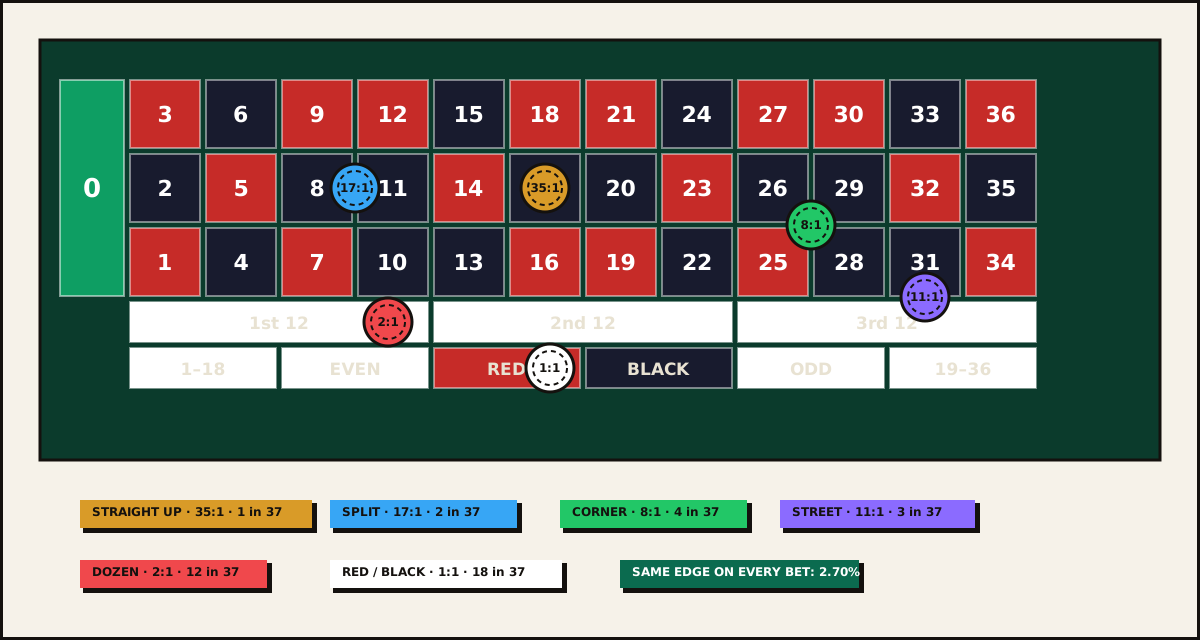
| Bet | Covers | Pays | Chance | House edge |
|---|---|---|---|---|
| Straight up | Single number | 35:1 | 1 in 37 | 2.70% |
| Split | Two adjacent numbers | 17:1 | 2 in 37 | 2.70% |
| Street | Three numbers in a row | 11:1 | 3 in 37 | 2.70% |
| Corner | Four numbers in a square | 8:1 | 4 in 37 | 2.70% |
| Six line | Two adjacent rows | 5:1 | 6 in 37 | 2.70% |
| Column / Dozen | Twelve numbers | 2:1 | 12 in 37 | 2.70% |
| Red / Black | Eighteen numbers | 1:1 | 18 in 37 | 2.70% |
| Odd / Even | Eighteen numbers | 1:1 | 18 in 37 | 2.70% |
| 1–18 / 19–36 | Eighteen numbers | 1:1 | 18 in 37 | 2.70% |
These three operators carry European Roulette or its closest live equivalent, and were the fastest to pay out in our testing. Codes below have no expiry date.
Roobet
Best overall for roulette
 Rainbet
Biggest headline package
Rainbet
Biggest headline package
 Stake
Deepest live roulette lobby
Stake
Deepest live roulette lobby
Screens from the Roobet roulette section, where our editor's pick runs European Roulette or its closest live
equivalent. Code roospins has no expiry date.
Double-zero wheel. The extra pocket nearly doubles the house edge to 5.26%.
Single zero plus La Partage — even-money bets lose only half when zero lands.
Straight bets pay 29:1, but one to five struck numbers pay 50x to 500x.

Former live-casino dealer turned probability writer. Builds every simulator on this site.
Yes. It runs entirely in your browser with a $1,000 play-money balance, requires no account and has no cash value. You can reset the balance as often as you like.
2.70%. Over a long session that is the percentage of everything you stake that the game keeps, regardless of which bets you choose.
Yes. Pockets are drawn uniformly and payouts match the standard paytable shown on this page. What a real table adds is real money, a dealer or provider RNG certification, and table limits.
No. There is no deposit, no withdrawal and no prize of any kind. It is a learning and testing tool. If you want to play for real money, the casinos listed further down this page offer European Roulette or a close equivalent.